**Silver Medal, Short Stories,
2015 Feathered Quill Book Awards
**Winner - Short Stories, 2015 Pacific Book Review Book Awards
Interviews for Prism:
-- Interview with Cynthia Brian, host of 'Starstyle'
on Voice America. Interview segment is at minute 22 on the program
slider. Visit
Voice America to hear the interview.
-- Interview with Linda Maria Frank on 'The Writers Dream':
5 Star
rating from Readers' Favorite.
Three reviewers comments follow.
(Review by Ioana Marza for
Readers' Favorite)
Prism is a collection of short stories that span multiple locations,
times and worlds. Roland Allnach has a great talent for creating worlds,
building an atmosphere and painting for the reader a believable setting
for each story. His power of description is considerable. The style of
writing is diverse and changes from one story to another. “Titalis” is
akin to a Greek tragedy, “Of Typhon and Aerina” is all in epic verse,
while several of the stories belong to the science fiction and
paranormal genres. Some of the writing styles are easier to read than
others, but the stories are all very well written. When he is not
constructing tragedies that feel as genuine as something taken out of
mythology, Allnach is writing stories in an almost ambiguous way which
makes them interesting and mysterious without becoming confusing.
A glass prism separates white light into a spectrum of colours, and this
is an apt title for Roland Allnach’s book. The most simple or even
trivial activity such as a child’s fear of darkness or a bored pupil’s
imagination running wild while at school becomes a big adventure when
seen through his prism. The theme of war is most recurrent, specifically
the human traits (whether good or bad) that drive people to war. Honour,
love, deceit, hunger for power - they are all seen through the Prism of
Allnach’s imagination. The whole collection of stories is interesting
and intriguing and sometimes even moving. There is a dark element in
most of them. I definitely enjoyed it and would strongly recommend it.
(Review by Lisa Jones for
Readers' Favorite)
Prism by Roland Allnach is a wonderful
collection of short stories which manage to capture the imagination. I
became hooked from the beginning on this enthralling eclectic collection
of rare delights. I think that the mixture is just right and there is
something for everyone here. The author did get great feedback in the
preview to this book, which always makes the read more enjoyable, and I
knew I would not be disappointed. Out of them all, my favourite has to
be the first story with the soldier whose men had all died. He goes
looking for water and his life changes forever. I found this captivating
and imaginative and could not stop reading.
Roland Allnach delivers a wonderful collection of stories in Prism. It
was cleverly written in a way which attracted the reader from the
outset. Each story was different and unique. I think there is something
for all tastes and I expect to be seeing more great things from this
author. The development of the plots and characters had just the correct
balance and I was just taken away into the realms of my own imagination.
I look forward to another similar collection from this author and I
would highly recommend this book to all. It brings an air of mystery,
along with witty and wonderfully delivered tales. Prism will certainly
be one of those rare books to add to my collection of precious finds.
Overall, I would say that you are missing out if you don't read this
book.
(Review by Rattan Whig for
Readers' Favorite)
A timeless, exquisite collection of
short stories that's bound to leave you mesmerized and awestruck.
The compilation is a masterpiece, besides being lifelike in many ways.
The selection of stories indicates a true literary master at work. Each
story itself is superbly written and offers glimpses into some of the
less visited areas of human psychology. The stories tend to relate to a
constant stream of boundless energy and the forces at work in the human
mind. That the human mind is the true master of each person's outward
behavior and inner thoughts is known and well respected, yet the depths
are untested and unknown to a large extent. What these depths hold and
exactly how it manifests as a reflection is the deeper mystery. The
reality tends to get lost in the quagmire of thoughts for it is the
thoughts that define our reality. Reality and the perception of reality,
or, in other words thoughts and fantasies, take on a different meaning
under stressful circumstances and preclude the owner from acting in
their best interest. For some, this defines the life that they live each
day while for some others it is the sign of things to come. Yet, one
unmistakable fact is their presence and their influence on everything
around.
Much of what we don't understand about being human is inside our head.
Popular line I read somewhere, dismissed as another interesting choice
of words, yet so true in the context. How could the human mind be so
majestic and frighteningly unfamiliar, so inviting yet so fear-invoking,
so brilliant to imagine yet so fearful in reality? Why does the reality
differ for each person? Why is there no rest even while one is
surrounded by all the creature comforts? The answers to these and
similar questions may not be the prerogative of this book as much as it
is the thought provoking and curiosity raising element many of the
stories succeed in inducing. A wonderful and memorable read!
Review of 'Prism' in Feathered Quill Book
Reviews
Reviewed by Amy Lignor
When you think of the word,
'prism,' you think of glass; that triangular shape with refracting
surfaces at acute angles that separate white light into a spectrum of
colors. It is not an overstatement to say that this author, with this
collection of the best of his short stories along with his newest
creations, is most definitely that 'spark' of pages that shoots a
spectrum of colors through the mind and imagination.
There are too many to delve into for a review, so selecting some of the
most extraordinary (which was difficult, considering the writing never
fails to entertain), is what to do in order to attempt to frame the
pictures that Allnach has created.
In the very beginning the reader opens to the world of a soldier; a
soldier who is in thought, considering he's all that’s left of what
everyone assumed would be a triumphant army. The promise of this battle
to the people had been that it would be swift - with the golden armored
soldiers making sure to defeat a smaller, less-armed, less-experienced
culture that was basically fighting with passion. There are morals here
galore, with the foundation
telling that money and nobility do not equal success when put up against
a man who lives and dies for their beliefs. Readers watch the solider
deal with his survival, deal with his own valor, and stay loyal to his
oath to protect a city that he can no longer defend. Among him his
madness, savages, and a woman who needs that soldier’s protection no
matter what the cost. The tale is "After the Empire," and the plot is
vivid, dramatic, and extremely enticing.
A young boy sits in the classroom, like most, bored with the reality of
school. Engaging his imagination the boy becomes "The Great Hunter,"
heading into a world through his drawings and mind, where predators must
be slain...and perhaps where new prey can be found back in reality.
Bone-chilling fear makes the reader want to hide under their own bed in
"Creep." William, the grad student who has found a once-in-a-lifetime
discovery and rushes to share the news with his Professor in "Apogee,"
learns the valuable lesson that when something comes once, perhaps it is
the most loved and most supportive person in your life who should head
the news...making one of those moments that rarely happen during a
lifetime. The 5-Acts of "Titalis" take the reader's breath away, as a
journey to a place of lost glory is taken,
where minds and souls work and play.
On and on this collection goes, with tales for literally everyone's
tastes. Each genre is spoken for - from the Technicolor world of sci-fi
to humor to horror to fantasy, and beyond. Allnach has a voice that
speaks so loud readers lose themselves in the stories, making this a
whole lot of fun!
Quill says: Just like a prism, this is a dazzling collection.
Review
of 'Prism' for Rebecca's Reads
Reviewed by F.T. Donereau
Author Roland
Allnach, in his new collection of stories, titled, “Prism,” has
taken the risk of alienating readers with too varied a selection
of genres. Everything is in the stew here: futuristic tales,
love stories, horror, on and on, filling the pot with all manner
of ingredients. How easily this might have backfired. After all,
how many of us indulge in so many different styles of
storytelling? At first I wondered why in the world Mr. Allnach
would do it. The answer, in my mind, has now become a simple
thing: he is blessed with an abundance of imagination, and
either could not contain it, or, wisely I now believe, chose not
to. Here you have the splendor of falling into worlds wholly
designed by the author, then finding others more grounded in
real life scenarios. You have heartbreak and fear and love and
Sci-Fi. You have, in the end, pure, unadulterated creativity.
And what (in this case, nothing, absolutely nothing) could be
wrong with that.
Mr. Allnach surprises with each new story here. You must open
your mind to difference, to receiving your entertainments in
different forms. It can be hard for a reader to do this; we are
trained to hold one plate of food at a time. If such habits can
be put aside, “Prism” will shatter you into countries that
glimmer, stories that entrance. The themes of life are the same
no matter how they are presented. If prejudices are put in a
drawer, locked from sight and ability to interfere, you will be
given hours of pleasure. Roland Allnach is a storyteller. He can
conjure and feed the head things that keep a reader turning
pages. You have pieces like, Icon, an interior work, hard
boiled, wherein a modern day, unnamed `Critic' exposes the price
of obsession, the pain of exploitation. Later, you come upon,
Titalis, a story which draws a world long gone, an ancient place
of hills and plains and war and warriors. The grit of it can be
tasted, the actuality of what no longer exists, brought alive
fully. With, Turn of the Wheel, Allnach uses colloquial
language, a first person narrator, plain spoken, to give a
straight forward, morbid account of family tragedy. Something
for everyone? More like everything for anyone in love with fine
literature.
“Prism” is a
book of stories written with precision. It does not dance with
overwrought stylings. Instead it chisels out what is needed with
laser description, true to the ear dialogue, characters built
into believability, and stories that capture the attention.
Forget about picking the genre you're most attracted to; widen
the avenues, take all of them in. Doing so will give what is
most wanted: the pleasure of living tales un-lived before. Mr.
Allnach is no light weight. Below the surface of many of his
stories things are swimming that must be thought about to be
discovered. Layers are important because they reveal. This
collection is to be savored, read again and gain. The gift
received for your time will be enormous. More, and better than
that, it will be fun.
Review of 'Prism' at
Bestsellersworld
Reviewed by Douglas Cobb
Just like prisms
reveal brilliant colors of the spectrum,
so does Roland Allnach’s collection of
short stories, Prism, reveal a
wide spectrum of brilliantly written
short fiction written by a master
storyteller. The majority of the 17
short stories in Prism have
been previously published in venues
ranging from Rose & Thorn Journal
to Bewildering Journal.
Prism is like a collection of
greatest hits that just keep on coming,
each successive tale better than the
preceding one, but all of them crafted
and refined by a genius wordsmith.
This review won’t
discuss every single one of the gems
within the pages of Prism, as
that would somewhat spoil the joy that
readers of this fine collection owe to
themselves to experience firsthand.
However, I will mention a few of the
short stories to give you a tantalizing
taste of the banquet of tales that await
you.
The first short
story in Prism is “After
the Empire.” It was originally
published in the Summer 2008 issue of
The Armchair Aesthete. The tale is told
primarily through the thoughts and
perspective of a soldier who still seeks
stubbornly to defend his city despite
its having been overrun by a ruthless
enemy. The soldier is sick, hungry, and
thirsty, but he is persistent in
honoring what he feels is his duty.
The only other
character who speaks and attempts to
befriend the soldier is a woman who had
been a servant in the household of a
wealthy man’s family. Everybody except
for her has been killed. She is the only
one left. When the soldier meets her, he
asks her if she has a horse he can use
even before he asks for some water to
drink. The soldier is stubborn, perhaps
due to a sense of loyalty; or, perhaps
because he knows no other way of life.
“11,”
the second tale in the collection, was
originally published in the Fall 2008
issue of Allegory. The story is about a
man, Carl, who feels as if he has been
tormented by an unseen person ever since
he was a young boy. The tormentor seems
to delight in destroying any tiny hints
of happiness in Carl’s life, killing a
pet dog that he had when he was a boy,
burning down his parents’ house with
them trapped inside, ruining any chances
he might have had at love and a real
life. What is the significance of the
number "11" and the tattoo of it that
Carl, who becomes a janitor, has on his
hand? You will have to read the story to
find out!
The third short
story in Prism, “Icon,”
first appeared in the January 2009 issue
of Midnight Times. The story tells about
a music critic, who is known wherever he
goes as just “the critic.” He can make
or break the musical acts he sees with
just a few lines in his column. In “Icon,”
he becomes infatuated with a particular
act, a woman who sings punk music,
drinks vodka and vomits on the stage.
The critic treasures every encounter he
has with her, even the most fleeting
ones. He bails her out of jail several
times yet never turns his back on her,
even when he, himself, is criticized for
losing his objectivity.
These three
wonderful short stories are just the
beginning of Prism by Roland
Allnach. He writes of tragic love,
serial killers, aliens, and many other
topics, and includes elements of
speculative fiction, myths, science
fiction, and horror in the 17 tales in
this latest collection. If you are
looking for an excellent collection of
short stories from one of today’s
premier authors, look no further than
Prism by Roland Allnach!
Review of
'Prism' at Pacific Book Review
Rated 5 out of 5 Stars
Reviewed by Jason Lulos
Quite an intriguing and
thought-provoking storyteller. Each
piece in this collection is literally
and figuratively engaging. In short,
Allnach's abilities as a storyteller in
transporting the reader to fantastic
worlds is obvious, but these tales also
lend themselves to allegorical
comparison with current issues, private
to sociological. The wide cast of
characters in this collection range from
the pathetic to the triumphant to the
homicidal and psychotic. The collection
could have aptly been called “Tragedy
and Comedy” but that would have been too
cliché. There is plenty of tragedy, some
comedy, numerous elements of the surreal
and always with hints of suspense. He
keeps you guessing. In this collection,
you will find short stories reminiscent
of Poe's style of the grotesque,
troubled mind. You will also find epic
poetry, Shakespearean tragedy, and
occasionally some comic relief. There is
something for everyone, but the roads in
most of these stories are dark and
paradoxically laden with hope and
hopelessness.
The
final story, “Dissociated” is on the
cyclic nature of things, writing, and
life. A nice way to close, considering
the first story, “After the Empire,” is
about the end of things. Although there
is a wide range of issues and genres in
Prism, there is the sense of a
continuum, much like a concept album
where the songs exist on their own but
somehow synthesize together. The soldier
in “After the Empire” willingly fights
for a lost cause. The protagonist in
“11” fights against his own
subconscious. The critic in “Icon”
fights against the media's sycophantic
infatuation with celebrity; and thereby
fights against himself. So, there is
this continuum of struggle, reflection,
rebuilding, reconciliation. In
“Memento,” Henry tries to reconcile by
reaching out to his enemy's family.
Internal psychological struggle and
actual war parallel each other like the
two faces of a prism, with multiple
angles of introspection and allegorical
interpretation on the sides. Dark as
they are, they invite the reader to look
at struggle as difficulty but also as an
accepted challenge, and there is
optimism in that pessimism. It's not all
Sisyphean. Allnach provides levity with
the nose-picker in “The Great Hunter”
and the poem “Tumbleweed” otherwise
titled “An Ode to a Well Endowed
Gunslinger.”
I
have to mention “Beheld” as a really
interesting look on creation itself. But
where Allnach really goes out on a limb
is with “Titalis” and “Typhon and
Aerina.” Titalis is a tragedy with
Shakespearean themes and the flowery
language to boot. “Typhon and Aerina” is
an epic poem written in classical style.
This makes an interesting juxtaposition
in the collection; so much science
fiction is set in the future, but these
are ambiguous as they could be in the
distant past, the distant future, or in
some parallel universe. This calls to
mind the Family Guy mockery of Star Wars
noting the tale is “in a galaxy far, far
away but somehow in the future.” Kidding
aside, this is the mark of a good
science fiction writer; to give tales
some linear ambiguity, leaving it up to
the reader to decide if they've already
happened or have yet to be.
Review of
'Prism' at Hollywood Book Reviews
Rated 4 out of 5 Stars
Reviewed by Ella Vincent
Prism by author Roland Allnach shows the
full spectrum of his creativity,
storytelling skills, vivid imagination
and although may be a bit frightening at
times, he is always entertaining.
Prism is a collection of Roland
Allnach’s newest short stories and
acclaimed poetry all in one book.
Allnach’s short stories are compelling
and engaging tales. The stories are
haunting and graphically terrifying; in
a good way. One standout tale is “11’’
about a man driven to unspeakable acts
by his bullying tormentor.
Another intriguing story is “Icon.’’
That story details the dysfunctional
relationship between a Courtney
Love-like troubled female rock star and
an obsessed music critic. One story,
“Creep’’ is a simple story about a boy
battling monsters he creates that sends
an evocative message about fear. Some of
the stories are graphically violent, but
teach a subtle lesson about obsession,
cruelty, and love.
Allnach’s stories also feature other
genres, like science fiction in “ The
City of Never,’’ dystopian fantasy
fiction in “After the Empire’’ and
long-form poetry like “Of Typhon and
Aerina.’’ There’s even some humor in
Prism in the midst of all the drama and
horror. One poem, “ Tumbleweed (An Ode
to a Well-Endowed Gunslinger)’’ is a
humorous look at a Wild West lawman.
Allnach’s genres vary and so do his
characters. Many of them are tragic, but
also have an underlying gentle humanity,
like the rock singer in “Icon.’’ The
fictional settings of places like
Eurimedon in “Titalis’’ come to life as
a brilliant example of Allnach’s
storytelling skills.
Allnach’s adult fiction would be perfect
for horror fans that love the
spine-tingling stories of authors such
as Stephen King. The science-fiction and
fantasy stories would also be great for
Game of Thrones fans that want more
adult fantasy fiction to add to their
collections. Prism would also be a great
addition to libraries’ horror or
science-fiction sections.
The stories are so vivid, they could
easily be made into a horror series,
similar to Tales from the Crypt.
“Titalis’’ could also be turned into a
book series of its own with its rich
characters and storylines. Allnach’s
writing asks a lot of provocative
questions, and readers will enjoy trying
to find the answers.
Prism shows the full range of Roland
Allnach’s unique writing. The collection
of stories will introduce readers to new
worlds and new ways of looking at
traditional book genres. Author Roland
Allnach’s award-winning literature shows
that short stories can leave a
long-lasting impact on readers.
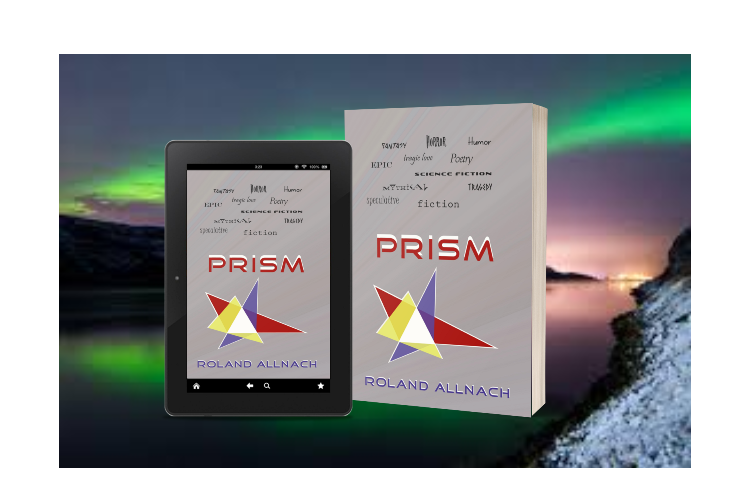
The
book cover for Prism offers a glimpse
into a formidable journey of the mind.
Your sensibilities will be shocked,
appalled, energized, scared, saddened,
and relieved as you forge your way
through chapters of fantasy, horror,
mythology, war, tragedy, humor, and
speculative fiction. A compendium of
many of Allnach’s award winning and
Editor’s Choice stories previously
published, Prism is a science
fiction adventure appearing real.
His
previous book, Oddities and Entities,
centered on the speculative,
supernatural, and the paranormal,
written in a style that I labeled
“poetic prose”. In Prism,
Allnach, continues the odyssey of grim,
gruesome, groaning eruptions that
shatter one’s perception of normalcy.
Cannibalism, insanity, and incest are
equally examined alongside topics of
love, lunacy, and gossamer lightness of
being. Without warning, we are pulled
into the depths of darkness then
rocketed to the radiance of blinding
brightness, all within a few pages.
Prism is an emotional roller coaster.
Without a doubt, Allnach is a literary
genius painting portraits that
simultaneously repulse and attract.
Whether his subjects are wilting or
witty, the poetry of his words conspires
to entrap the reader in a web of
seduction. After reading Prism, you’ll
want to know the back-story of how he
hatches his ideas. Has he heard tales of
such horrors during his twenty-year
night watch at the hospital? Has he
witnessed true-life experiences that
have transitioned into his prose? Are
his writings derived from a vibrant
imagination, terrifying nightmares, or
raucous reality?
Only
Allnach can answer these questions and I
intend to ask him on his next visit to
my radio program, Starstyle®-Be the Star
You Are!® In the meantime, pick up Prism
and prepare for a wild ride, an E ticket
with steel seat belts required.
The
optimism resides in the truth that
Roland is on a roll…stay tuned!
Cynthia
Brian is Producer/Host of StarStyle®-Be
the Star You Are!® Radio and a New York
Times best selling author.
All original
content copyright by Roland Allnach. Content may be linked and/or
quoted, but not reproduced without permission. RETURN TO TOP /
RETURN TO HOME